If you get a chance, visit their web site and reserve your tickets - this is going to be a great show www.WBFFShows.com
Adrian Burke - www.FUSIONBodybuilding.com

When you go to the gym and train, it is a very systematic process, essentially all one does is lift, push, pull the weights. However, it is damn enjoyable. When one is training, there are certain principles one should consider when heading off to the gym or going for a run.
Law of Overload
The principle of overload is perhaps one of the most important and obvious concepts - if one does not push themselves harder (i.e. lifting more weight with proper form, running further) the body has no need to adapt, and thus one will not make any desirable gains in strength and/or endurance.
One can ‘overload’ themselves by adjusting one of the following:
Law of Reversibility
Simply stated, “If you don’t use it, you will lose it”. If you are not training consistently, the body has no need to adapt. So the gains that you have made in the gym will slowly start to relapse.
It is also important to note that one shouldn’t train so frequently that the body goes into a state of over training. Rest is needed for the body to recover.
Some symptoms of over training:
Irritability and moodiness
Altered sleep patterns
Loss of appetite
Loss of motivation or competitive drive
Persistent muscle soreness that does not go away
Fatigue not relieved by rest
Increased incidence of minor illness or injury
Principle of Variety
Doing the same thing over and over again gets boring rather quickly. Incorporating different exercises for each body part will keep your body guessing, and not grow accustomed to the routine you are using. Instead of doing low rep squats; try doing light weight 20 rep squats. Or instead of barbell shrugs, try dumbbell shrugs.
Law of Specificity
The exercise or training that you do will elect a certain and specific response and adaptations. Specific anaerobic exercise stress (i.e. strength-power training) induces specific strength-power adaptations; endurance exercise stress elects a specific aerobic system adaptations. There is only a limited interchange of benefits between strength and cardiovascular training.
So if you have a single goal in mind, train specific for that goal and not something else. If you want big legs don’t go continually training biceps.
Law of Individuality
Everyone is different. Different training routines affect each person in a different way. Some people will respond very well to high reps and light weight exercises, while others will only respond to heavy weight and low rep exercises. So if someone says “You have to try this new routine, it worked wonders for me.” Feel free to try it out, but don’t get disappointed if it doesn’t work out for you.
Kurt Kuhn - www.FUSIONBodybuilding.com
High intensity exercise of short duration (ie.100m dash, 25m or heavy ass squats) requires an immediate energy supply. This comes almost soley on banked stores of intramuscular, high-energy phosphates, phosphagens, adenosine triphosphate (ATP) and phosphocreatine (PCr). Each kilogram of skeletal muscle (the kind of muscle you use when you workout) contains 3 to 8 mmol/l (millimoles/litre) of ATP and 4–5 times more PCr. For a 70kg person, with a muscle mass of 30kg, this represents between 570 to 690 mmol/l of high-energy phosphates. Assuming that 20kg of muscle becomes active during “big-muscle” exercise, sufficient stored phosphagen energy can supply energy for 5-8 seconds of sprint running for 5–8 seconds, or up to 15 seconds of heavy, maximal effort weight lifting.
All sports use the high-energy phosphates, but many depend almost entirely on this means of energy transfer. For example, success in football and the gym requires brief but maximal efforts during the performance. Sustaining exercise beyond a brief period and recovering from all-out effort requires an additional energy source to replenish ATP. If this does not occur, the “fuel” supply diminishes and high-intensity movement comes to a screeching halt. The carbohydrates, fat, and protein found within the cellular fluids and tissue depots remain ready to continually recharge the available pool of high-energy phosphates to sustain muscular activity. However, there are other methods of help maintaining this energy currency. This is where creatine comes into play.
When creatine is consumed it passes through the digestive tract intact and eventually gets shuttled into skeletal muscle. About 40% exists as free creatine; the remainder combines with a phosphate molecule to form PCr.
PCr also shuttles intramuscular high-energy phosphate between the mitochondria and muscle filament cross-bridge sites that initiate muscle action. Maintaining a high ratio of ATP:ADP (adenosine diphosphate) ratio is important for maximum effort activities lasting up to 3-15 seconds. This exercise duration places high demands on ATP re-synthesis that exceed the energy transfer from intracellular macronutrient breakdown.
Generally speaking, creatine has the potential to accomplish the following:
- Accelerate ATP turnover to maintain power output during short-term muscular effort
- Delay PCr depletion
- Diminish dependence on anaerobic glycolysis and decrease resulting lactate formation
- Facilitate muscle relaxation and recovery from repeated bouts of intense, brief effort via faster ATP and PCr resynthesis; rapid recovery allows continued higher level power output
Molecular Structure of PCr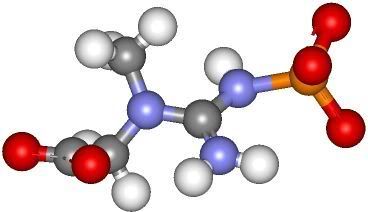
Molecular Structure of ATP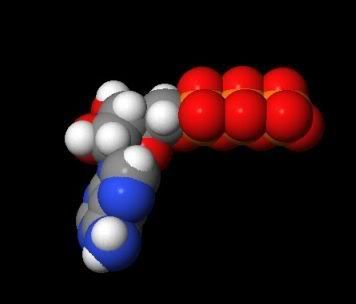
Kurt Kuhn - http://www.fusionbodybuilding.com/
The Central Nervous System - The Spinal Cord
The spinal cord attaches to the brainstem providing a critical pathway for the flow of information from the skin, joints and muscles to the brain, and vice versa.
In cross sections of the spinal cord there is a H-shaped center of gray matter. The ventral (anterior) and dorsal (posterior) horns describes the sections of this core. The spinal cord core contains primarily three types of neurons: motor neurons, sensory neurons, and interneurons. The motor neurons (efferent) run through the ventral horn to supply skeletal muscle. Sensory (afferent) nerve fibers enter the spinal cord from the periphery by way of the dorsal horn. The white matter, containing the ascending and descending nerve tracts, surround the gray matter within the cord.
As previously mentioned, information going towards the brain is sensory information, such as touch, taste and also pain. So if you are working out and pull a muscle or drop a 45 lb plate on your small toe the nerves will travel up to the brain via afferent nerve fibers of the spinal and the information will be integrated there. Here the response will be traveling via afferent nerve fibers to produce a motor response.
Ascending Nerve Tracts
Ascending nerve tracts in the spinal cord send sensory information coming from peripheral receptors to the brain for processing. There are three neurons that typically make up sensory pathway.
1) The dorsal root ganglion contains the cell body of the first neuron whose axon relays information into the spinal cord.
2) The cell body of the second neuron lies within the spinal cord itself; its axon passes up the spinal cord to the thalamus.
3) The thalamus contains the third neuron's cell body. The axon of the third neuron passes up to the central command center of the cerebral cortex
Descending Nerve Tracts
Axons from the brain move downward through the spinal cord along two major pathways. The lateral or pyramidal tract activates the skeletal muscle (the muscles that you primarily use when working out). The second pathway named ventromedial or extrapyramidal tract, controls posture and muscle tone via the brainstem.
Kurt Kuhn - www.FUSIONBodybuilding.com