
You're a bodybuilder, an Iron Warrior, A Disciple of past champions – so chances are good that you wan't a big, strong beyond ripped body that's the best there is,with no ugly fat hiding all of your hard work. If this is you, then add one more thing to your “must do” bodybuilding list: eat fresh berries.
It's true: on the surface, berries don't seem essential for bodybuilders – they're low in protein and light on calories – and they certainly won't build muscle like a nice thick steak. But there's new evidence that fresh berries can stop you from getting fat – and not getting fat is always better than having to lose fat.
Many berries such as blueberries contain special blue/purple/red pigments called anthocyanins, and science shows that they can help prevent obesity, even when consuming a relatively high-fat diet. The research pointed out that grape skins, blueberries, blackberries and purple corn are rich in these fat fighters, but other foods contain them as well.
So here's your FUSION FACTOID: Eat dark colored fresh berries whenever possible. Insodoing you'll not only benefit from their antioxidant effects, but you'll be keeping the fat away.
SOURCE:American Chemical Society (2008, February 14). Natural Purple Pigments In Fruits, Vegetables And Berries, Such As Blueberries, May Help Prevent Obesity.
- FUSION Research Team
www.fusionbodybuilding.com
Tuesday, February 26, 2008


Tuesday, February 19, 2008
Once You Start Working Out - KEEP IT UP!
You hear it all the time: “you have to be consistent with your workouts if you hope to build muscle and burn fat” and “being consistent is the only real way to make any gains.”
While we all know that this advice is true for muscle building and fat burning, new science is shedding light on the age-old practice of taking breaks between training phases.
It's a common practice for bodybuilders to take a one-week break or rest period at the end of bulking and cutting cycles. This is done primarily to rest the body and allow it to “normalize” in anticipation of the start of a cutting or bulking phase and the corresponding changes in training practices.
But new science shows that taking a total break can make you fat. In fact, the science shows that missing workouts and taking extended breaks from exercise – not exercising consistently – increases your chances of getting fat - more so than eating fatty foods!
So here's the straight-talk from FUSION: If you're reaching the end of one training-phase and about to start another, don't take a total break from activity. Instead, continue doing light cardiovascular exercise, or play a sport. Do something – just don't become a couch potato. This will not only stop you from getting fat, but it will keep your conditioning up so you have less “catch-up” work to do once you get back in the game.
Source: DOE/Lawrence Berkeley National Laboratory (2008, February 9). Irregular Exercise Pattern May Add Pounds.
- FUSION Research Team
www.fusionbodybuilding.com
While we all know that this advice is true for muscle building and fat burning, new science is shedding light on the age-old practice of taking breaks between training phases.
It's a common practice for bodybuilders to take a one-week break or rest period at the end of bulking and cutting cycles. This is done primarily to rest the body and allow it to “normalize” in anticipation of the start of a cutting or bulking phase and the corresponding changes in training practices.
But new science shows that taking a total break can make you fat. In fact, the science shows that missing workouts and taking extended breaks from exercise – not exercising consistently – increases your chances of getting fat - more so than eating fatty foods!
So here's the straight-talk from FUSION: If you're reaching the end of one training-phase and about to start another, don't take a total break from activity. Instead, continue doing light cardiovascular exercise, or play a sport. Do something – just don't become a couch potato. This will not only stop you from getting fat, but it will keep your conditioning up so you have less “catch-up” work to do once you get back in the game.
Source: DOE/Lawrence Berkeley National Laboratory (2008, February 9). Irregular Exercise Pattern May Add Pounds.
- FUSION Research Team
www.fusionbodybuilding.com
Tuesday, February 12, 2008
Wanna Be BIG? Can The Beer...
It's a fact: bodybuilders exist to build rock-hard, eye-popping muscle – to get huge!
To get huge, you have to eat and lift heavy. Some bodybuilders – especially younger bodybuilders – have taken to drinking beer because of the common misconception that the added calories from beer can aide in muscle building. Not so.
Science shows that alcohol doesn't just prevent muscle growth, but it also makes you fat – and keeps you that way.
Alcohol is calorie dense – with each gram of alcohol packing a whopping 7.5 calories. per gram) These empty calories increase your overall energy intake, and also negatively impact your hormone profile by supressing beta-adrenergic receptor activity – the activity that triggers fat incineration.
Bottom Line: Beer makes your fat and keeps you that way.
So next time you're thinking about having a brew, can the beer instead and focus on increasing your testosterone and muscle growth the right way: by working out hard and eating right.
Source: Endocrinology, in press; published online June 22, 2006.
- FUSION Research Team
www.fusionbodybuilding.com
To get huge, you have to eat and lift heavy. Some bodybuilders – especially younger bodybuilders – have taken to drinking beer because of the common misconception that the added calories from beer can aide in muscle building. Not so.
Science shows that alcohol doesn't just prevent muscle growth, but it also makes you fat – and keeps you that way.
Alcohol is calorie dense – with each gram of alcohol packing a whopping 7.5 calories. per gram) These empty calories increase your overall energy intake, and also negatively impact your hormone profile by supressing beta-adrenergic receptor activity – the activity that triggers fat incineration.
Bottom Line: Beer makes your fat and keeps you that way.
So next time you're thinking about having a brew, can the beer instead and focus on increasing your testosterone and muscle growth the right way: by working out hard and eating right.
Source: Endocrinology, in press; published online June 22, 2006.
- FUSION Research Team
www.fusionbodybuilding.com
Tuesday, February 05, 2008
A FAMILY AFFAIR
At FUSION we are fortunate enough to have a stream of great testimonials about how our products have helped bodybuilders around the world achieve their goals. But, there is one testimonial that really stood out. It is from a bodybuilding dad who had great success with PURPLE•K and was so confident in it, that he recommended his 20 year old son use it. Well, we were totally stoked when Andrew Collins sent in this picture of his son - introducing Khris Collins. WOW - what a great combination of dedication, hard work and smart supplementation. Keep training bad ass Khris - you never know where it will take you.
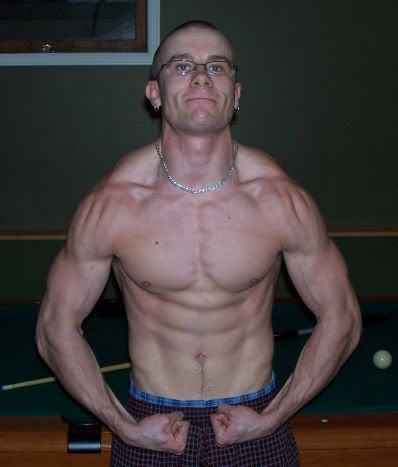
Khris Collins - bodybuilder to the core
- FUSION Media
Thursday, January 31, 2008
Wednesday, January 30, 2008
WANT POWERFUL LEGS? STEP-UP!
It's a fact: if you want a powerful physique, you need big quads. Your quads are the largest muscle group in your body and comprise half of your physique – so skipping that leg workout can lead to disproportional development and a lack of functional strength and muscular symmetry. Ultimately, this can lead to injury.
While squats are undeniably effective not only for leg development but for overall development and strength, science shows that dumbbell step-ups are, in fact, superior to all other leg exercises for quadriceps strength development and muscular growth.
How so? It's simple: squats place the weight load across your back in a balanced fashion, but dumbbell step-ups not only work your quadriceps but also force you to develop and use maximum control over your body balance in order to properly execute the exercise and maintain correct body position from beginning to end.
So while squats are an indispensable, foundation exercise, and while many other exercises are useful growth-triggering tools in your arsenal, do step-ups if you want to build big quads.
Source: Strengthening Conditioning Journal, 28:60-61, 2006.
- FUSION Research Team
www.fusionbodybuilding.com
While squats are undeniably effective not only for leg development but for overall development and strength, science shows that dumbbell step-ups are, in fact, superior to all other leg exercises for quadriceps strength development and muscular growth.
How so? It's simple: squats place the weight load across your back in a balanced fashion, but dumbbell step-ups not only work your quadriceps but also force you to develop and use maximum control over your body balance in order to properly execute the exercise and maintain correct body position from beginning to end.
So while squats are an indispensable, foundation exercise, and while many other exercises are useful growth-triggering tools in your arsenal, do step-ups if you want to build big quads.
Source: Strengthening Conditioning Journal, 28:60-61, 2006.
- FUSION Research Team
www.fusionbodybuilding.com
Thursday, January 24, 2008
SICK SPIT
Every bodybuilder knows that there's a downside to hard-training: getting sick. Bodybuilders have known for years that while training hard is needed to get strong and build serious muscle, overtraining is sometimes just a rep away. In a new study, researchers tried to figure out part of the reason why training can make you sick, and they think they've found part of the answer: it's in your spit.
Researchers tested a team of World-class rowers, and wanted to see how intense exercise affected levels of lactoferrin and lysozyme – two immune system saliva proteins that kill microbes. High levels of these proteins is a good thing, and low levels not good – if levels get too low, you get sick.
After examining saliva samples from these athletes taken before and after an intense workout, scientists discovered an intense workout lowers the total count of these protective proteins, so your body kills of less microbes – making it easier for you to get sick.
It's not clear why training has this effect, but to combat your risk of getting sick, researchers recommend drinking plenty of water during exercise to flush out potentially harmful bacteria. We also recommend supplementing with vitamin C for oxidant protection and eating plenty of protein so you heal faster.
Source: West, Nick. Griffith University. Elite Athletes More Susceptible To Common Illnesses, Research Suggests.
- FUSION Research Team
www.fusionbodybuilding.com
Researchers tested a team of World-class rowers, and wanted to see how intense exercise affected levels of lactoferrin and lysozyme – two immune system saliva proteins that kill microbes. High levels of these proteins is a good thing, and low levels not good – if levels get too low, you get sick.
After examining saliva samples from these athletes taken before and after an intense workout, scientists discovered an intense workout lowers the total count of these protective proteins, so your body kills of less microbes – making it easier for you to get sick.
It's not clear why training has this effect, but to combat your risk of getting sick, researchers recommend drinking plenty of water during exercise to flush out potentially harmful bacteria. We also recommend supplementing with vitamin C for oxidant protection and eating plenty of protein so you heal faster.
Source: West, Nick. Griffith University. Elite Athletes More Susceptible To Common Illnesses, Research Suggests.
- FUSION Research Team
www.fusionbodybuilding.com
Wednesday, January 23, 2008
WBFF Kicks Off - 2008 Season
After the huge success of the WBFF World Championships last September, things are ramping up again for a great season. The WBFF's first of a string of hot-bod contests will be on March 15. Check out the poster below. You can find more information at www.wbffshows.com

- FUSION - Media
www.fusionbodybuilding.com
- FUSION - Media
www.fusionbodybuilding.com
Tuesday, January 08, 2008
Post-Exercise Calorie Burn
For years it’s been thought and taught that the way to burn more calories following your workout is to increase the total volume of your training, either by increasing the number of total sets that you perform over the course of your workout, by increasing the total number of repetitions per set that you perform, or by increasing both set and repetition count. Millions of bodybuilders have followed this advice hoping to increase post-exercise calorie burn. Unfortunately, while popular, this approach is wrong and doesn’t work.
The fact is, while lifting weights does burn calories and keeps your metabolism higher than normal once your workout is finished, nothing beats cardio in the calorie burning department. And, while doing more reps and sets during your workout will slightly increase the total calories you burn while in the gym, only cardio keeps your metabolism high and burning calories long after you’ve left the gym.
Source: International Journal Sports Medicine, 27:143-148, 2006.
- FUSION Research Team
http://www.fusionbodybuilding.com/
The fact is, while lifting weights does burn calories and keeps your metabolism higher than normal once your workout is finished, nothing beats cardio in the calorie burning department. And, while doing more reps and sets during your workout will slightly increase the total calories you burn while in the gym, only cardio keeps your metabolism high and burning calories long after you’ve left the gym.
Source: International Journal Sports Medicine, 27:143-148, 2006.
- FUSION Research Team
http://www.fusionbodybuilding.com/
Thursday, December 20, 2007
HAPPY HOLIDAYS!
Well, it's that time of the year where caloric intake should never be a concern or questioned - EAT and GROW!
On behalf of FUSION I'd like to thank everyone for your support this past year. It's been an honor to get to know many of you and to see how bodybuilding has impacted your life. It truly is the most focused and dynamic sport in the world - you should be proud to be a bodybuilder. I wish you and your families the best of luck in '08 - keep working hard.
AND - may all your Christmas trees be ripped!!!
- Adrian Burke, Co-Prez
http://www.fusionbodybuilding.com/
On behalf of FUSION I'd like to thank everyone for your support this past year. It's been an honor to get to know many of you and to see how bodybuilding has impacted your life. It truly is the most focused and dynamic sport in the world - you should be proud to be a bodybuilder. I wish you and your families the best of luck in '08 - keep working hard.
AND - may all your Christmas trees be ripped!!!
- Adrian Burke, Co-Prez
http://www.fusionbodybuilding.com/
Tuesday, December 11, 2007
FUSION - FREE INSIDE
Aside from developing the reputation as being bodybuilding's strongest supplements, FUSION has been hard a work thinking of how to bring you more added value. The solution has been to give FREE tools and information with every FUSION product. Inside every box of FUSION's products you'll find a fuctional tool to help you achieve you bodybuilding goals. This is what you'll find:
SUB•Q - 50-Page Beyond Ripped Diet and Training Manual
PURPLE•K - Strength Tracking Poster and Pro-Bench Tips
ZEUS - Report on Testosterone and Gym God Program
FUBAR - (is being re-packaged to incorporate some bad ass motivational stickers)
Our focus will always be on making the strongest supplements in bodybuilding, but you deserve more. We want to help you as much as we can to make sure you have every possible tool at your disposal to mazimize you bodybuilding potential.
- Chris Belanger www.fusionbodybuilding.com
SUB•Q - 50-Page Beyond Ripped Diet and Training Manual
PURPLE•K - Strength Tracking Poster and Pro-Bench Tips
ZEUS - Report on Testosterone and Gym God Program
FUBAR - (is being re-packaged to incorporate some bad ass motivational stickers)
Our focus will always be on making the strongest supplements in bodybuilding, but you deserve more. We want to help you as much as we can to make sure you have every possible tool at your disposal to mazimize you bodybuilding potential.
- Chris Belanger www.fusionbodybuilding.com
Monday, November 26, 2007
GOT SQUATS?
It kills me that so many guys in the gym tend to stay away from training their legs – they procrastinate. When leg day comes around they make up excuses such as, “bad knees”, “bad back”, or, “I don’t want to bulk up – I am looking for more definition”.
Here’s the truth: a properly executed squat will help you benefit drastically from bad knees since it will help strengthen the muscle around the knee joint and increase the stability. The same goes with having a bad back – when properly executed the squat will strengthen the supportive tissue throughout the back and spine.
For those who say they are not looking to bulk up in the legs and they would prefer to perform leg extensions or legs curls, or use abductor-adductor machines to obtain more definition, forget it. You will only bulk up if you are consuming enough calories to do so.
Some benefits to performing squats are: increased bone density, an increase in core strength, increase in stamina and an increase in lower body strength and stability.
Another good reason that you should perform squats is to increase the anabolic hormone testosterone. Testosterone allows you to build lean muscle, reduce body fat, improve mood, and increase sexual performance. If you are stuck at a plateau on your bench, there’s a good chance hitting some good squats will elevate your testosterone enough to break it.
If you are not sure how to perform a squat properly, speak to a certified personal trainer and have him or her go over the movement. Even if you think you know how to perform a squat, I suggest you have a qualified individual take a second look to make sure you are performing it correctly.
Make sure you have a good warm-up and stretch before performing squats. I prefer to do my cardio at the end of my leg workout, as the increase in oxygen will help eliminate the build-up of lactic acid – the burn. Finally, take the next 10-15 minutes for a good stretch.
So, don’t forget about your squats and remember: procrastination is just like masturbation – it seems like a good thing at the time, but in the end you’re only fucking yourself.
- Chris Belanger www.fusionbodybuilding.com
Here’s the truth: a properly executed squat will help you benefit drastically from bad knees since it will help strengthen the muscle around the knee joint and increase the stability. The same goes with having a bad back – when properly executed the squat will strengthen the supportive tissue throughout the back and spine.
For those who say they are not looking to bulk up in the legs and they would prefer to perform leg extensions or legs curls, or use abductor-adductor machines to obtain more definition, forget it. You will only bulk up if you are consuming enough calories to do so.
Some benefits to performing squats are: increased bone density, an increase in core strength, increase in stamina and an increase in lower body strength and stability.
Another good reason that you should perform squats is to increase the anabolic hormone testosterone. Testosterone allows you to build lean muscle, reduce body fat, improve mood, and increase sexual performance. If you are stuck at a plateau on your bench, there’s a good chance hitting some good squats will elevate your testosterone enough to break it.
If you are not sure how to perform a squat properly, speak to a certified personal trainer and have him or her go over the movement. Even if you think you know how to perform a squat, I suggest you have a qualified individual take a second look to make sure you are performing it correctly.
Make sure you have a good warm-up and stretch before performing squats. I prefer to do my cardio at the end of my leg workout, as the increase in oxygen will help eliminate the build-up of lactic acid – the burn. Finally, take the next 10-15 minutes for a good stretch.
So, don’t forget about your squats and remember: procrastination is just like masturbation – it seems like a good thing at the time, but in the end you’re only fucking yourself.
- Chris Belanger www.fusionbodybuilding.com
Wednesday, November 14, 2007
VITAMIN C - don't forget about it.
It is commonly known that vitamin C is a powerful nutrient. Mainly due to its ability to prevent colds and keeping you scurvy free. But, it’s lesser known benefits are those that can help you be a better bodybuilder.
Plasma ascorbic acid, vitamin C in your blood, has been shown to have an inverse relationship to degenerative joint pain and osteoarthritis. This is because vitamin C is needed for collagen synthesis and the repair of it. What does this mean to you? It means it can help reduce the pain, or prevent the pain that you get from doing heavy compound movements like squats.
It has also been shown that a person low in vitamin C can have more trouble burning fat. This is because vitamin C is needed for the formation of carnitine, a biological molecule needed for adipolysis, the metabolism of fat tissue. So take your vitamin C supplementation seriously and watch how the addition of it can change your performance.
References
Evangelou A, et al., Ascorbic acid (vitamin C) effects on withdrawal syndrome of heroin abusers.
In Vivo. 2000 Mar-Apr; 14(2):363-6.
Johnston CS, et al., Marginal vitamin C status is associated with reduced fat oxidation during submaximal exercise in young adults. Nutr Metab (Lond). 2006 Aug 31; 3:35.
McAlindon TE, et al., Do antioxidant micronutrients protect against the development and progression of knee osteoarthritis?Arthritis Rheum. 1996 Apr; 39(4): 648-56.
KURT KUHN - Bodybuilding Researcher
www.fusionbodybuilding.com
Plasma ascorbic acid, vitamin C in your blood, has been shown to have an inverse relationship to degenerative joint pain and osteoarthritis. This is because vitamin C is needed for collagen synthesis and the repair of it. What does this mean to you? It means it can help reduce the pain, or prevent the pain that you get from doing heavy compound movements like squats.
It has also been shown that a person low in vitamin C can have more trouble burning fat. This is because vitamin C is needed for the formation of carnitine, a biological molecule needed for adipolysis, the metabolism of fat tissue. So take your vitamin C supplementation seriously and watch how the addition of it can change your performance.
References
Evangelou A, et al., Ascorbic acid (vitamin C) effects on withdrawal syndrome of heroin abusers.
In Vivo. 2000 Mar-Apr; 14(2):363-6.
Johnston CS, et al., Marginal vitamin C status is associated with reduced fat oxidation during submaximal exercise in young adults. Nutr Metab (Lond). 2006 Aug 31; 3:35.
McAlindon TE, et al., Do antioxidant micronutrients protect against the development and progression of knee osteoarthritis?Arthritis Rheum. 1996 Apr; 39(4): 648-56.
KURT KUHN - Bodybuilding Researcher
www.fusionbodybuilding.com
Monday, October 29, 2007
My SND Experience.
This past weekend Sport Nutrition Depot and Popeye’s Supplements across Ontario, Canada had their Customer Appreciation Day. I was lucky enough to be in the Waterloo, SND location on Saturday and WOW – the service was great! The last experience that I had of this type of service was when I attended the Mr. Olympia in the adult fun park of Las Vegas. For those of you who have ever attended one of their stylish nightclubs you will know what I am talking about. You walk in and this big-ass doorman greets you with a smile and asks where you would like to sit and even takes your coat – gets the waitress over to you and the drink is in your hands minutes later. Well this is what it felt like walking through the door at Sport Nutrition Depot in Waterloo. The big-ass doorman opened the door, gave me a greeting, and cleared the path through one hell of a line-up that can’t be described, and I took care of my business. A killer experience!
- Chris Belanger - www.Fusionbodybuilding.com
- Chris Belanger - www.Fusionbodybuilding.com
Monday, October 15, 2007
Reasons and Methods for Improving Grip Strength
There are some very valid reasons why an individual would want to improve grip strength:
1) Boost one’s ego – a bit shallow, yes.
2) Will provide symmetry to a physique, so your biceps and triceps don’t over power the forearms in a pose.
3) Perhaps most importantly, help you lift more weight on certain exercises such as dead lifts and rows, and this can potentially help you achieve insane numbers.
The methods for improving grip strength are numerous, but they all encompass one aspect - don’t neglect your forearms in the gym! Thankfully, a variety of methods are available on how you can train your forearms. You can add hammer curls, which would hit both your forearms and biceps. Or superset reverse wrist curls and wrist curls using a thick barbell. All of this can be done the same day you hit your biceps, or even back. Another method is using a kettle bell, which is an old school version of the dumbbell and always one to do a single exercise with one apparatus. To view some different exercises using a kettle bell and improving grip strength, check out this great article on Bodybuilding.com.
www.bodybuilding.com/fun/jasonbrown2.htm
Often people ask if it’s all right to use wrist straps in the gym. In my opinion straps should only be used under certain conditions and should not be used for every exercise, or if it neglects your back training. Say you burned out your grip doing a few sets of heavy dead lifts, and your grip is the failing out point. Now would be a good time to use straps – preferably chalk, however, only if your gym allows it.
- Kurt Kuhn www.fusionbodybuilding.com
1) Boost one’s ego – a bit shallow, yes.
2) Will provide symmetry to a physique, so your biceps and triceps don’t over power the forearms in a pose.
3) Perhaps most importantly, help you lift more weight on certain exercises such as dead lifts and rows, and this can potentially help you achieve insane numbers.
The methods for improving grip strength are numerous, but they all encompass one aspect - don’t neglect your forearms in the gym! Thankfully, a variety of methods are available on how you can train your forearms. You can add hammer curls, which would hit both your forearms and biceps. Or superset reverse wrist curls and wrist curls using a thick barbell. All of this can be done the same day you hit your biceps, or even back. Another method is using a kettle bell, which is an old school version of the dumbbell and always one to do a single exercise with one apparatus. To view some different exercises using a kettle bell and improving grip strength, check out this great article on Bodybuilding.com.
www.bodybuilding.com/fun/jasonbrown2.htm
Often people ask if it’s all right to use wrist straps in the gym. In my opinion straps should only be used under certain conditions and should not be used for every exercise, or if it neglects your back training. Say you burned out your grip doing a few sets of heavy dead lifts, and your grip is the failing out point. Now would be a good time to use straps – preferably chalk, however, only if your gym allows it.
- Kurt Kuhn www.fusionbodybuilding.com
Thursday, October 04, 2007
THE MUSCLE TIMES
Hey guys - we just launched the registration page for THE MUSCLE TIMES.
THEMUSCLETIMES.COM
The Muscle Times is our quarterly newsletter, but this isn't about Fusion - it's about you and the bodybuilding culture. What you'll get when you sign-up for The Muscle Times is some great training tips, athlete interviews, current bodybuilding news and the odd rant. I hope you enjoy it and thanks for all your support.
- Adrian Burke
THEMUSCLETIMES.COM
The Muscle Times is our quarterly newsletter, but this isn't about Fusion - it's about you and the bodybuilding culture. What you'll get when you sign-up for The Muscle Times is some great training tips, athlete interviews, current bodybuilding news and the odd rant. I hope you enjoy it and thanks for all your support.
- Adrian Burke
Wednesday, September 12, 2007
NAC Linked to Hypertension
N-Acetyl L-Cysteine (NAC) is an amino acid that has been shown to increase the levels of the antioxidant glutathione. The antioxidant can reduce cell damage, speed recovery from injury and aid muscle growth. The anabolic effect of NAC on muscle tissue makes it a popular supplement for bodybuilders who want to gain lean muscle size and strength.
However, I came across a recent article, which was published in the Journal of Clinical Investigation examining the effects of NAC. The study indicated that the antioxidant properties can form a red blood cell-derived molecule that makes blood vessels think they are not getting enough oxygen. This can lead to pulmonary arterial hypertension (PAH), which is a condition characterized by high blood pressure in the arteries carrying blood to the lungs.
I have used N-Acetyl L-Cysteine for a few years now at 1500mg daily and consider it a foundation supplement for antioxidant purposes and will continue its usage. However, the recent article published in the Journal of Clinical Investigation should not be taken lightly and if you have any concerns about taking this supplement to discuss it with your doctor first.
Chris Belanger – www.FUSIONBodybuilding.com
However, I came across a recent article, which was published in the Journal of Clinical Investigation examining the effects of NAC. The study indicated that the antioxidant properties can form a red blood cell-derived molecule that makes blood vessels think they are not getting enough oxygen. This can lead to pulmonary arterial hypertension (PAH), which is a condition characterized by high blood pressure in the arteries carrying blood to the lungs.
I have used N-Acetyl L-Cysteine for a few years now at 1500mg daily and consider it a foundation supplement for antioxidant purposes and will continue its usage. However, the recent article published in the Journal of Clinical Investigation should not be taken lightly and if you have any concerns about taking this supplement to discuss it with your doctor first.
Chris Belanger – www.FUSIONBodybuilding.com
Wednesday, August 29, 2007
Biological Functions of Amino Acids – Part 2
Conditionally Essential Amino Acids Functions
Arginine
- Plays a role in cell division, healing of wounds and removal of ammonia from the body
- Important for immune function and the production of T lymphocytes
- Integral in protein synthesis
- Precursor to nitric oxide which has many physiological functions, including vasodilation
Cysteine
- Provides an antioxidant function by being a pre-cursor to glutathione
- Source of sulfur
- Aids in hair growth
Glutamine
- Potential to be converted to glucose
- Maintains physiological pH levels of blood
- Increases the production of human growth hormone
Glycine
- Essential for synthesis of nucleic acids, bile acids, ATP and creatine
- Acts as an inhibitory neurotransmitter, and increases activity of certain neurotransmitters
- Stimulates glucagon
Proline
- Strengthens myocardium
- Precursor for hydroxyproline, which the body uses for tendons and ligaments
- Important component of collagen, which aids in the maintenance and healing of cartilage and joints
Tyrosine
- Precursor for the neurotransmitters: epinephrine, norepinephrine, and dopamine
- Can be converted to melanin, which protects against ultraviolet light
Nonessential Amino Acids Functions
Alanine
- Vital for the function of the central nervous system
- Maintains blood glucose levels
- Can be converted to glucose during intense bouts of exercise
- Aids in the production of lymphocytes, which is used in immune function
Asparagine
- Used as a transport of nitrogen in the body
- Essential function in proteins used in neuronal signaling, neuron development and transmission across synapses
Aspartate
- Used in gluconeogenesis, the creation of glucose
- Serves as an excitatory neurotransmitter
Glutamate
- Most readily available excitatory neurotransmitter
- Is a precursor for GABA (gamma-aminobutyric-acid)
- Key role in transamination
Serine
- Used in the metabolism of fats and fatty acids
- Aids in the production of immunoglobulins and antibodies
Kurt Kuhn - www.FUSIONBodybuilding.com
Monday, August 13, 2007
2007 Candian Nationals
We're all heading to Edmonton to see the Nationals this weekend. It's going to be an awesome event with some great competition - so if you get a chance, be sure to make your way there.
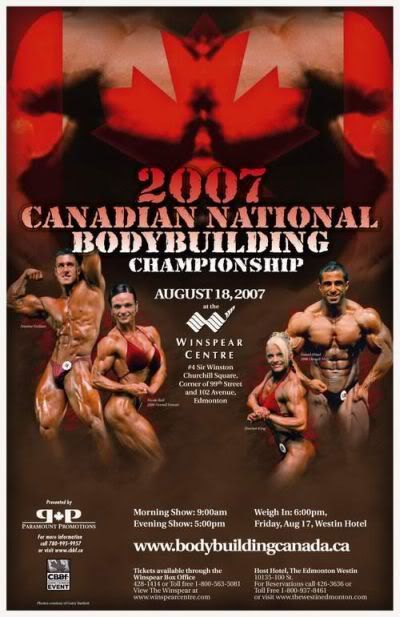
I'd personally like to wish the best for FUSION athlete Dave Naugler. This guys been working non-stop since his Middleweight win last year. Kick some ass Dave - you're a real bodybuilder - 100% pure dedication.
See you there!
- Adrian Burke http://www.fusionbodybuilding.com/
I'd personally like to wish the best for FUSION athlete Dave Naugler. This guys been working non-stop since his Middleweight win last year. Kick some ass Dave - you're a real bodybuilder - 100% pure dedication.
See you there!
- Adrian Burke http://www.fusionbodybuilding.com/
Wednesday, August 08, 2007
Biological Functions of Amino Acids
General Overview of Amino Acids
The most common purpose of protein we know of is for its purpose to help repair damaged muscle tissue after a workout. Protein has other functions, such as: aid in the transport of oxygen to tissues; play a role in immune function, so we don’t get sick; help control our mood. All of these doings are possible by the basic building blocks of protein, amino acids.
There are over twenty different amino acids, each one with a specific function in a physiological system. There are many ways of categorizing them. The most common way of sorting them is into categories: essential, conditionally essential and non-essential amino acids.
Essential amino acids are those that the body cannot synthesize, or it cannot create enough of. So it must be consumed via diet.
Conditionally essential amino acids are amino acids that are not always needed, but in certain individuals they are. Such as: a young and growing individual, or during illness.
Non-essential amino acids are just that. The body can synthesize enough of it to maintain normal function, so it does not need to be consumed through diet.
Essential Amino Acids Functions
Histidine
- A precursor of histamine, a compound released by the immune system when an allergic reaction occurs.
- Needed for the repair and growth of tissues. As well as the maintenance of the myelin sheath that is found in the neuronal cells.
- Needed for the creation of red and white blood cells.
Isoleucine
- Helps aid in the recovery of muscle tissue after physical stress (i.e. working out).
- Used in for formation of blood clots.
- Synthesis of hemoglobin.
- Has a stimulating effect for muscle metabolism, repair and growth of tissue.
- It is a BCAA, can be used as energy source in muscle tissue, and doing so prevents the use of muscle glucose.
Leucine
- A BCAA that prevents the breakdown of muscle tissue.
- Maintains and regulates the blood-sugar tissues.
- Aids in the growth and repair of muscle tissue and bones.
Lysine
- Required for the bone development in children.
- Needed to produce antibodies, hormones, enzymes, and the repair of tissues.
- Assists in calcium absorption.
- Maintains a correct nitrogen balance, and maintains a lean body mass.
Methionine
- Aids in the breakdown of fats.
- Acts as an antioxidant.
- Used in the formation of creatine in the body.
Phenylalanine
- Helps elevating mood.
- Aids in memory and learning.
- Has been used as an appetite suppressant.
Threonine
- Required to maintain a proper balance of protein in the body.
- Assists in the formation of collagen and elastin in the skin.
- When combined with aspartic acid it has lipotropic functions.
- With the aid of methionine assists in immune function by producing antibodies.
Tryptophan
- Required for the biosynthesis of niacin (vitamin B3).
- Used to produce serotonin, an important neurotransmitter, which is important in sleep.
Kurt Kuhn - www.FUSIONBodybuilding.com
Subscribe to:
Posts (Atom)

